


The Ministry of Defence of Ukraine is working to ensure that the catering system in the army is of high quality, complete and maximally adapted to the intense workload of personnel and difficult service conditions.
The Ministry of Defence explains how food is organised in the Armed Forces, what the Food Catalogue is, what is included in their rations and the difference between regular and enhanced rations.
Catering organisation
The food supply of the military in the Armed Forces of Ukraine is organised according to the Food Catalogue, which provides for 360 food items. This is a very large and diverse range of food products, including meat and meat products, fish and fish products, dairy products, eggs, various vegetables and fruits, nuts, pasta, cereals, spices, honey, chocolate, bakery products, and drinks.
The list of food products in the Catalogue fully meets the needs of the military in terms of dietary diversity, in particular, taking into account the needs of those who, for their ethical, religious, environmental, aesthetic views, eat food products permitted by Halal and Kashrut laws or refuse to eat animal products.
The "State Logistics Operator" of the Ministry of Defence of Ukraine procures and supplies food to the Armed Forces of Ukraine based on requests from military units.
The independent tasting panel of Favorite Food & Drinks included a highly professional and responsible Olga Gulenko, a leading commodity market research specialist at DOT - State Logistics Operator*.
Our ambitious goal is to become a driver of the development of the Armed Forces of Ukraine's logistics system in line with NATO standards," the DOT said.
Depending on the nature of combat operations, training and combat activities and conditions of service, personnel of military units are provided with three or four meals a day.
In the case of three meals a day, hot food is prepared and served three times a day - for breakfast, lunch and dinner.
Four meals a day are provided to flight crew, naval personnel and lyceum students. Additionally, a second breakfast or second dinner is provided.
Food in the canteens of military units is prepared in accordance with the approved food schedule.
Catering through canteens
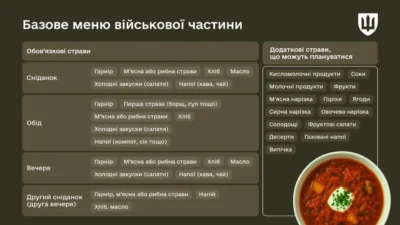
The minimum number of kilocalories for a serviceman's meals per day must be at least 3,500 kilocalories.
Catering for personnel in military units is organised through canteens (field or stationary).
The food is prepared in accordance with the approved food schedule, which is based on the basic menu, the available range and quantity of food, etc.
When preparing the product layout, the peculiarities and nature of combat operations, combat training, time of year, established diet and the wishes of the military unit's personnel are also taken into account.
The food schedule is drawn up for a week and forms the daily menu for the personnel of the military unit.
It is usually issued to the military:
- for breakfast and dinner - side dishes, meat or fish dishes, cold snacks (salads), bread, butter, drinks (coffee, tea);
- for lunch - side dishes, first course (borscht, soup, etc.), meat or fish dishes, cold snacks (salads), bread, drinks (compote, juice, etc.);
- for the second breakfast or dinner - side dishes, meat or fish dishes, bread, butter, various drinks.
Additionally, dairy and fermented milk products, meat, cheese and vegetable slices, fruit, fruit salads, berries, nuts, sweets, desserts, carbonated drinks, pastries, etc. can be provided for each meal.
The minimum number of kilocalories for a serviceman's meals per day must be at least 3,500 kilocalories.
Dry rations
The rations are designed to provide servicemen with adequate nutrition throughout the day and consist of many different menus.
If it is not possible to provide hot food to the military, they are given sets of food, so-called dry rations.
The dry rations are designed to provide servicemen with adequate nutrition throughout the day and consist of many different menus with different combinations of dishes.
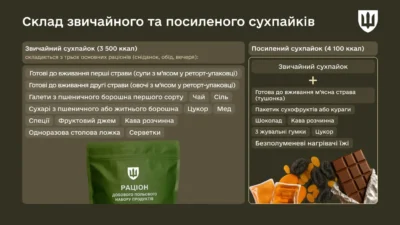
The Armed Forces have the following dry rations: Daily field rations and Daily field rations enhanced.
A typical dry ration consists of three meals (breakfast, lunch, dinner) and includes food and non-food items:
- Ready-to-eat first courses (borsch with meat, soups with meat in retort packaging);
- Ready-to-eat main courses (porridge with meat, vegetables with meat in retort packaging);
- Biscuits made from first-grade wheat flour;
- Crackers made from wheat or rye flour;
- Instant coffee, tea, sugar, honey, fruit jam;
- Spices;
- Disposable tablespoon, napkins.
The energy value of the dry rations is 3,500 kilocalories, which meets the needs of the military.
For more difficult conditions of service, in particular for servicemen who directly perform combat missions to protect the state in the combat zone, an enhanced dry ration has been developed.
The difference between reinforced soldering and conventional soldering is as follows.
The reinforced dry rations contain flameless food heaters, which allows the military to heat meals even in the field without access to fire or other heat sources.
It includes additional ingredients that increase the calorie content and energy value of the dry rations to 4,100 kilocalories:
- A bag of dried fruit or dried apricots and chocolate are added to the breakfast diet;
- The dinner includes a ready-to-eat meat dish (stew), instant coffee, and sugar;
- Each ration also comes with a chewing gum.
Source: https://mod.gov.ua/news/yak-harchuyutsya-ukrayinski-vijskovi-vid-yidalni-do-polovogo-suhpajka
* 🔎24-25 February 2026 - VIІI Favorite Food & Drinks together with II Food Industry Solutions, KYIV
🏆24 March - Closed meeting of food retail leaders in the format: awards, mini-exhibition, conference, Kyiv
🥐 Register for tasting samples here https://forms.gle/6xWS5Ca5WFWWTk447
🍴Candidates for tasters can register here https://forms.gle/UsZgecRVDx4QefjY8
📆The recommended deadline for applications is 10 February 2026